Kann ein Algorithmus fair sein? Technische und rechtliche Perspektiven [Can an Algorithm Be Fair? Technical and Legal Perspectives]
Type
Publication
In ailex, no. 3, pp. 123-130. MANZ (2026).
English title: Can an Algorithm Be Fair? Technical and Legal Perspectives.
Article written in German, published in ailex, no. 3 (2026), pp. 123-130, by MANZ.
Read the article on the publisher’s website.
TL;DR
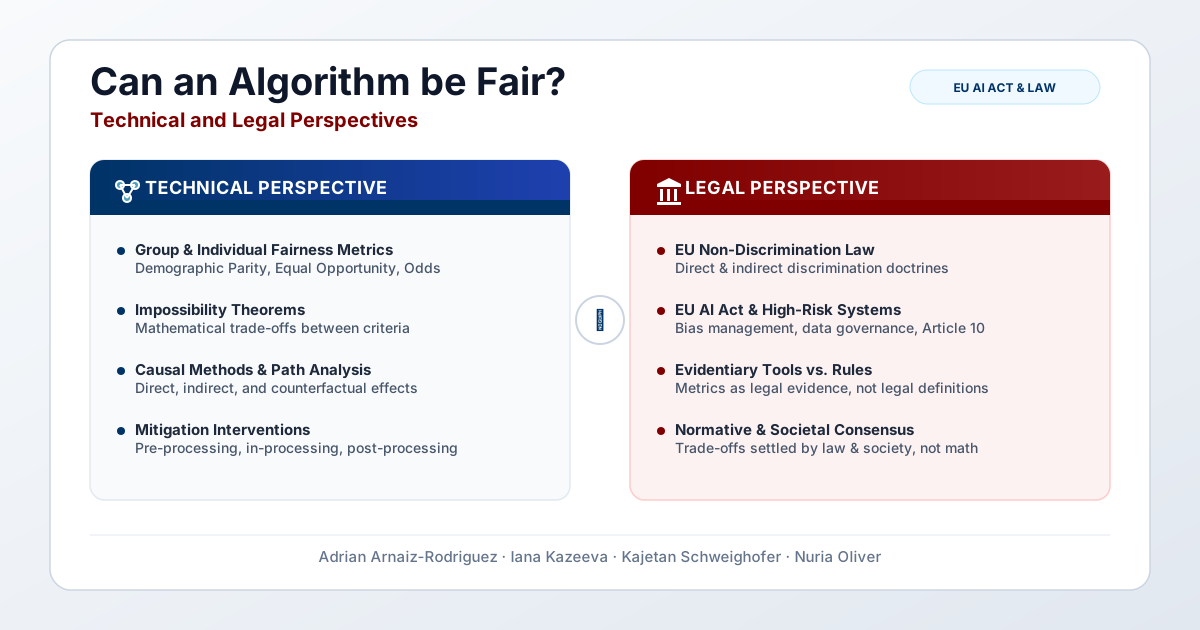
We bridge algorithmic fairness and EU non-discrimination law in one paper, providing:
- Mapping causal path-specific effects onto direct and indirect discrimination, while being explicit about the limits of that analogy.
- Guidance on choosing a fairness metric based on the decision context and the harm it should capture, treating metrics as evidence rather than legal rules.
- A section on how to assess fairness in practice: sampling and statistical power for small groups, intersectional subgroups, long-term effects, and how metrics can be gamed.
- An account of why mitigation needs protected attributes, tied to positive action and the AI Act’s special-category data rules, including the Digital Omnibus.
- An up-to-date review of how EU law handles algorithmic discrimination in high-risk AI systems, general-purpose AI, and online platforms (AI Act, DSA, GDPR, Digital Omnibus, CEN-CENELEC standard), including where the gaps are.
The takeaway: choosing what to equalize is a societal and legal decision, not a technical one.
Click the Cite button above to show and copy the BibTeX reference.

Adrian Arnaiz-Rodriguez
Postdoctoral Researcher
Postdoctoral Researcher in Trustworthy AI, AI Regulation and Graph Neural Networks @ ELLIS Alicante.