A Sociotechnical Approach to Trustworthy AI: from Algorithms to Regulation
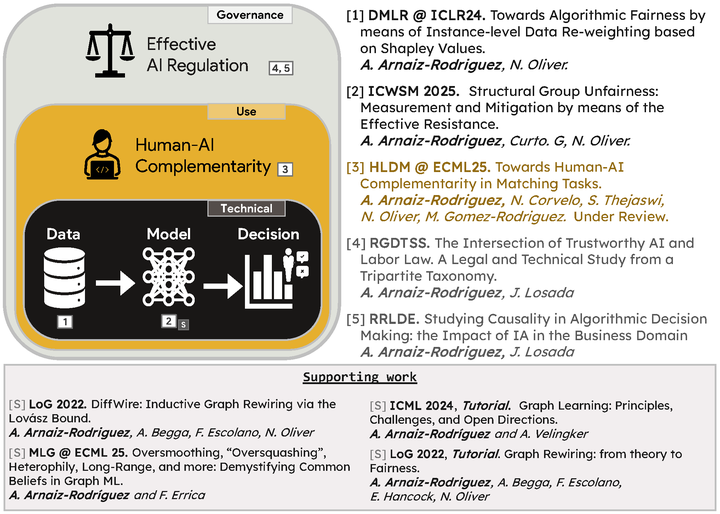 Trustworthy AI: balancing technical, human, and regulatory dimensions
Abstract
This thesis presents a sociotechnical framework for implementing Trustworthy Artificial Intelligence (TAI), integrating technical, human, and regulatory aspects. It emphasizes the importance of aligning algorithmic development with societal needs and legal standards throughout the AI lifecycle. First, the thesis focuses on algorithmic fairness and proposes two novel methods to mitigate algorithmic discrimination in decision-making (FairShap) and in social networks (ERG). Next, the thesis explores the challenge of provably optimal human-AI complementarity in a resource allocation task. Finally, the thesis investigates the interplay between AI and Spanish labor legislation. Concludes that trustworthiness in AI systems requires a holistic understanding of data, algorithms, institutions, and regulatory factors.
🏅 Ph.D. thesis evaluated with the highest honors (cum laude) by Isabel Valera (Saarland University), Ciro Cattuto (ISI Foundation), and Germán González Serrano (University of Alicante).
Read Adrian’s PhD thesis: PDF. See Adrian’s thesis defense presentation (2026/09/26): Video.
Summary
This thesis advances a sociotechnical framework for effectively implementing Trustworthy Artificial Intelligence (TAI) by aligning algorithmic techniques, human oversight, and regulatory practice throughout the AI lifecycle. It focuses on AI-induced harms and their mitigation through:
Algorithmic contributions
- FairShap: a novel instance-level data valuation method that measures each training example’s contribution to group-fairness metrics, enabling deeper diagnosis and mitigation of discrimination in high-risk decision-making and supporting EU AI Act auditing obligations.
- ERG: a graph-based method to quantify and reduce structural disparities in social capital within networks, relevant to systemic risk assessments under the EU Digital Services Act.
Human–AI complementarity
- A framework for collaborative decision-making in high-stakes matching tasks that jointly optimizes algorithmic decisions and bandit-based hand-off to humans—aiming to outperform humans or algorithms alone while adhering to TAI principles of robustness, oversight, and harm minimization.
Governance & law
- An analysis of AI for worker management under Spanish labor law, mapping legal duties across the lifecycle, and highlighting tensions such as correlation-based ML vs. legal requirements for causal justification in certain decisions.
Overall, the thesis argues that achieving TAI requires viewing trustworthiness as an emergent property of sociotechnical systems—the interplay of data, algorithms, institutions, and regulation—and provides practical guidance for researchers, practitioners, and policymakers.
Main publications discussed in the thesis
AO24 — Arnaiz-Rodriguez, A., & Oliver, N. (2024).
Towards Algorithmic Fairness by means of Instance-level Data Re-weighting based on Shapley Values. DMLR @ ICLR 2024.
Link: https://openreview.net/forum?id=ivf1QaxEGQACO25 — Arnaiz-Rodriguez, A., Curto Rex, G., & Oliver, N. (2025).
Structural Group Unfairness: Measurement and Mitigation by Means of the Effective Resistance. ICWSM 2025, 19(1), 83–106.
Link: https://doi.org/10.1609/icwsm.v19i1.35805ACTOG25 — Arnaiz-Rodriguez, A., Corvelo, N., Thejaswi, S., Oliver, N., & Gomez-Rodriguez, M. (2025).
Towards Human–AI Complementarity in Matching Tasks. HLDM @ ECML-PKDD 2025.
Link: https://arxiv.org/abs/2508.13285AL24a — Arnaiz-Rodriguez, A., and Losada Carreño, J. (2024). (EN: The Intersection of Trustworthy AI and Labour Law. A Legal and Technical Study from a Tripartite Taxonomy) La intersección de la IA fiable y el Derecho del Trabajo. Un estudio jurídico y técnico desde una taxonomía tripartita. Revista General de Derecho del Trabajo y de la Seguridad Social, Iustel, 69. [Iustel] Link: https://www.iustel.com/v2/revistas/detalle_revista.asp?id_noticia=427491
AL24b — Arnaiz-Rodriguez, A., and Losada Carreño, J. (2024). (EN: Studying Causality in Algorithmic Decision Making: the Impact of AI in the Business Domain) Estudio de la causalidad en la toma de decisiones algorítmicas: el impacto de la IA en el ámbito empresarial. Revista Internacional y Comparada de Relaciones Laborales y Derecho del Empleo, ADAPT, 12(3). Link: https://ejcls.adapt.it/index.php/rlde_adapt/issue/view/105
Supporting publications
ABEO22 — Arnaiz-Rodriguez, A., Begga, A., Escolano, F., & Oliver, N. (2022).
DiffWire: Inductive Graph Rewiring via the Lovász Bound. LoG 2022, PMLR 198:15:1–15:27.
Link: https://proceedings.mlr.press/v198/arnaiz-rodri-guez22a.htmlAE25 — Arnaiz-Rodriguez, A., & Errica, F. (2025).
Oversmoothing, “Oversquashing”, Heterophily, Long-Range, and more: Demystifying Common Beliefs in Graph Machine Learning. MLG @ ECML-PKDD 2025 (Best paper).
Preprint: https://arxiv.org/abs/2505.15547
Tutorials
ABEOH22 — Arnaiz-Rodriguez, A., Begga, A., Escolano, F., Oliver, N., & Hancock, E. (2022).
Graph Rewiring: From Theory to Applications in Fairness. Tutorial @ LoG 2022. Link: https://ellisalicante.org/tutorials/GraphRewiringAV24 — Arnaiz-Rodriguez, A., & Velingker, A. (2024).
Graph Learning: Principles, Challenges, and Open Directions. Tutorial @ ICML 2024.
Link: https://icml.cc/virtual/2024/tutorial/35233
Other publications not included in the thesis
- SAHO25 — Schweighofer, K., Arnaiz-Rodriguez, A., Hochreiter, S., & Oliver, N. M. (2025).
The Disparate Benefits of Deep Ensembles. ICML.
Preprint: https://arxiv.org/abs/2410.13831
Defense video
- Defense of the Doctoral Thesis — University of Alicante, 26/09/2025, 10:30.
Video: https://vertice.cpd.ua.es/308319
Adrian Arnaiz-Rodriguez
Research Scientist
Research Scientist at Apart Research, studying AI manipulation risks and developing AI evaluations.